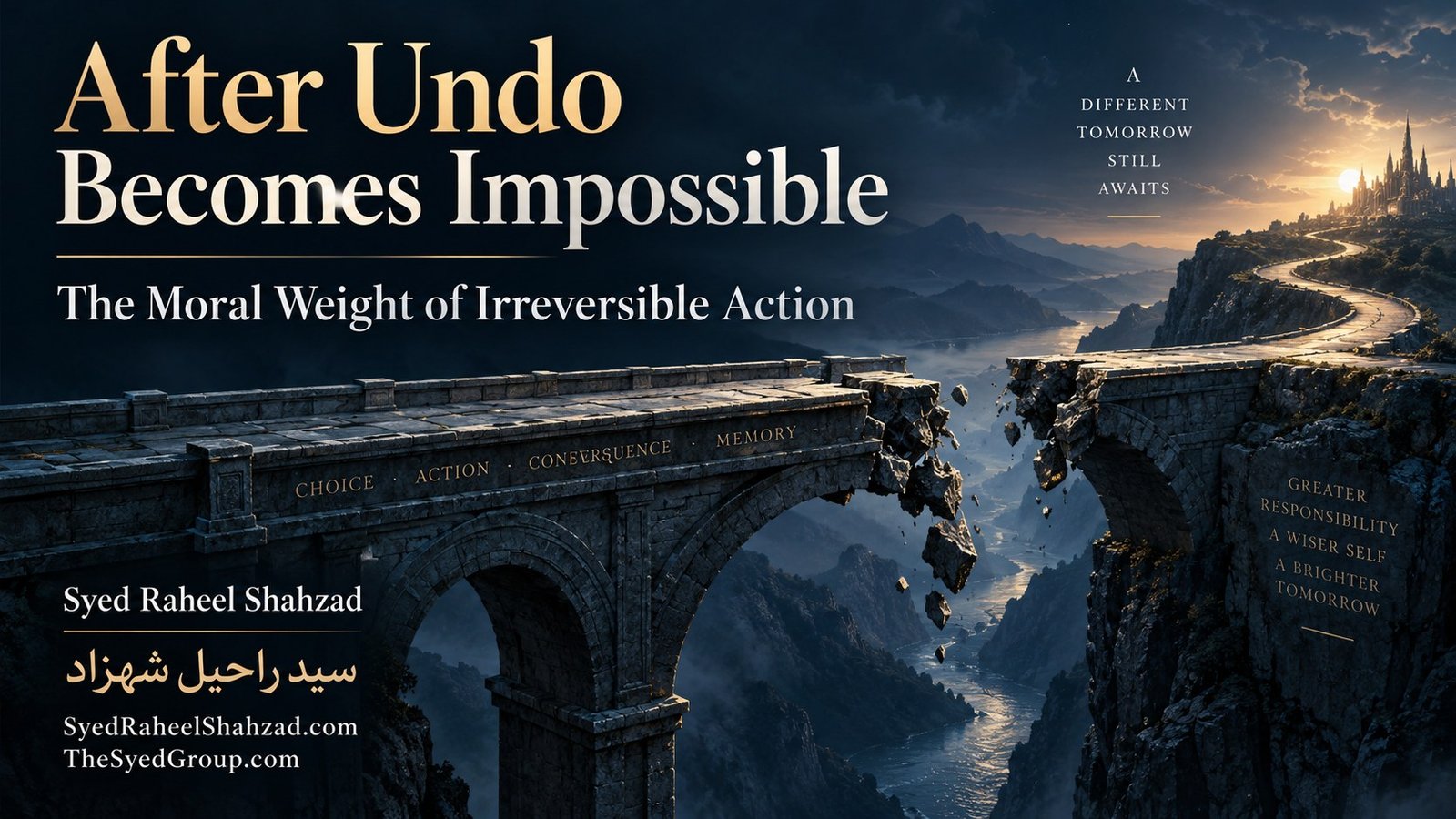
After Undo Becomes Impossible: The Moral Weight of Irreversible Action
Philosophical Essay · 5 September 2026 · Irreversibility, Repair and Answerability
After Undo Becomes Impossible: The Moral Weight of Irreversible Action
A philosophical inquiry into responsibility when apology can acknowledge, compensation can answer, and repair can begin—but the original world cannot be restored.
Human beings often speak about mistakes as though time were a surface that could be wiped clean. We apologize, correct the record, pay compensation, rebuild what was damaged, and then reach instinctively for the language of restoration: fixed, resolved, closed, back to normal.
But some actions do not leave the world in a condition that permits a return.
A confidence betrayed can be forgiven without becoming unbetrayed. A public accusation can be withdrawn without returning the opportunities lost while it was believed. A childhood missed cannot be rescheduled. A year taken from a life cannot be refunded. An institution may compensate a person after an unjust decision and still be unable to restore the exact career, relationship, health, trust, or historical moment that disappeared because of it.
Repair can change what follows an irreversible act. It cannot make the act never have happened.
This distinction—between repair and reversal—is morally decisive. It changes what responsibility means, what apology can honestly promise, what forgiveness does and does not accomplish, and how carefully power should act before consequences become permanent.
The moral fiction of the reset button
Modern life trains us to expect reversibility. Software has undo. Transactions can be reversed. Files can be restored. Products can be returned. Edits can be rolled back. The interface teaches a psychological habit: mistakes are temporary states awaiting correction.
Human life is not built this way.
Many morally significant acts enter time asymmetrically. The action may take seconds; its effects may reorganize years. A sentence can be spoken once and remembered for decades. A manager can make one decision that redirects another person’s career. A family can normalize one form of neglect until it becomes a child’s model of love. A government can authorize a measure whose consequences outlive the officials who approved it.
The mistake in moral reasoning is not believing repair matters. Repair matters enormously. The mistake is allowing the possibility of repair to disguise the impossibility of restoration.
Reversal, restoration, repair and compensation are different
These words are often treated as synonyms, but they describe different moral achievements.
Reversal removes or cancels an action while its effects remain sufficiently contained. A wrong charge can be reversed before it changes anything else.
Restoration returns a person or condition substantially to what existed before. Stolen property may sometimes be returned intact.
Repair addresses damage that cannot simply be removed. It may rebuild trust, correct a process, provide care, change behavior, or prevent repetition.
Compensation transfers something of value in response to a loss, even where the lost thing itself cannot be returned.
The moral danger begins when compensation is described as restoration, or apology is described as erasure. A payment can acknowledge a ruined opportunity; it cannot recreate the exact future that opportunity might have produced. A sincere apology can alter a relationship’s future; it cannot return the relationship to the innocence that existed before the betrayal.
The residue that remains
Irreversible action creates what might be called moral residue: the part of consequence that remains even after a responsible response has been made.
Residue is not proof that repair failed. It is evidence that reality has a history.
A scar may remain after healing. The scar does not mean the treatment was meaningless. It means healing and uninjuredness are different conditions. Moral life requires the maturity to accept the same distinction.
This matters especially for the person who caused harm. There is a temptation to demand that apology produce emotional absolution on a timetable convenient to the apologizer. “I admitted it. I changed. What more can I do?” The question may be sincere, but it can still conceal a wish for the injured person to certify that the past has disappeared.
No one is entitled to that certificate.
Forgiveness does not rewrite history
Forgiveness is often burdened with impossible expectations. It is asked to make the past harmless, restore intimacy, remove memory, cancel consequence and reassure the person who did wrong.
But forgiveness need not perform any of those tasks.
A person may forgive and still choose distance. They may release vengeance and still require boundaries. They may recognize genuine change while refusing to reconstruct the previous relationship. They may no longer wish punishment and still tell the truth about what happened.
Forgiveness can transform the moral relation to the past without altering the historical fact of the past.
That is not a weakness of forgiveness. It is what keeps forgiveness truthful.
Responsibility after irreversibility
If the past cannot be changed, what remains for the responsible person to do?
First, tell the truth without bargaining. Do not reduce the damage by pointing to intention, pressure, ignorance, or later regret before the consequence itself has been faced.
Second, distinguish what can still be repaired from what cannot. Practical responsibility becomes clearer when it stops promising impossible restoration.
Third, carry an appropriate share of the remaining burden. If another person continues to live with consequences produced by your action, moral repair should not require them to carry every cost alone.
Fourth, change the architecture that made repetition possible. Remorse that leaves the same habits, incentives, permissions, and patterns intact is emotionally sincere but structurally incomplete.
Fifth, accept that another person may not return to you. Responsibility is not a contract by which good conduct purchases reconciliation.
The asymmetry between destruction and rebuilding
One of the deepest facts of moral life is that destruction and construction rarely require equal time.
Trust may take ten years to establish and ten seconds to rupture. A reputation may be built through hundreds of acts and damaged by one believable allegation. A forest can take generations to mature and hours to burn. A public institution can accumulate legitimacy slowly and lose it in one moment of exposed contempt.
This asymmetry should change our ethics before action, not only after it.
The less reversible a consequence is, the greater the duty of imagination before creating it.
Foresight is therefore not merely prudence. Under conditions of power, it becomes a moral obligation. The person whose decision can alter other lives owes more than good intention. They owe disciplined consideration of what cannot later be put back.
Irreversibility and power
The ethics of irreversibility becomes especially important when the actor possesses institutional power. A private mistake may harm a few people. A system can distribute an error across thousands while keeping responsibility psychologically distant from every decision-maker.
Power increases the need for review because the scale of consequence increases. It also increases the duty to hear those who will carry the loss. People who can be affected permanently should not appear only after the decision as complainants; where possible, they should appear before the decision as sources of knowledge.
This is one reason systems thinking belongs inside moral philosophy. A system is not merely a mechanism for producing outcomes. It is an arrangement for deciding who may act, who must absorb uncertainty, whose warning counts, how error is detected, and whether harm can be reversed once produced.
The danger of permanent condemnation
There is another error to avoid. If irreversible harm cannot be erased, it may seem that the person who caused it should remain morally imprisoned inside that act forever.
That conclusion also misunderstands time.
The past is irreversible, but the person is not necessarily finished. Responsibility can become the beginning of a different moral future. A human being who has told the truth, accepted consequence, repaired what can be repaired, changed the relevant structure, and lived differently over time should not be required to pretend the act never happened—but neither should the act be treated as the only fact that can ever describe the person.
Moral seriousness requires both memory and proportion.
Without memory, accountability collapses. Without the possibility of transformation, accountability becomes metaphysical imprisonment rather than moral formation.
A mature relationship with the irreversible
To live among other people is to acquire a history that cannot be perfectly curated. We will be shaped by actions done to us, actions done by us, accidents, omissions, decisions made under incomplete knowledge, and moments we later understand differently.
Maturity is not the fantasy of leaving no irreversible trace. It is the discipline of understanding that some traces demand greater care before they are made and greater honesty after they are made.
The question after irreversible harm is therefore not, “How do I make it as though this never happened?”
The better questions are: What truth is now owed? What burden can still be lifted? What repair remains possible? What must change so this is not repeated? What boundary must I respect? What memory must the institution preserve? And what kind of person—or system—will exist because the event was finally understood?
Conclusion: after undo
We cannot build a serious ethics around a reset button that human life does not possess.
Some things can be restored. Some can only be repaired. Some can be compensated. Some can be forgiven. Some must simply be carried truthfully because no action can return the exact world that existed before.
But irreversibility is not the end of responsibility. It is where responsibility becomes most visible.
We are answerable not because we can always reverse what we have done, but because even when yesterday is fixed, tomorrow is still morally open.