The Silent Claim of the Future: Power, Irreversibility and Responsibility to the Unborn
Philosophical Essay · 29 August 2026 · Power, Time and Intergenerational Responsibility
The Silent Claim of the Future: Power, Irreversibility and Responsibility to the Unborn
Those who cannot participate in our choices may become their most permanent subjects.
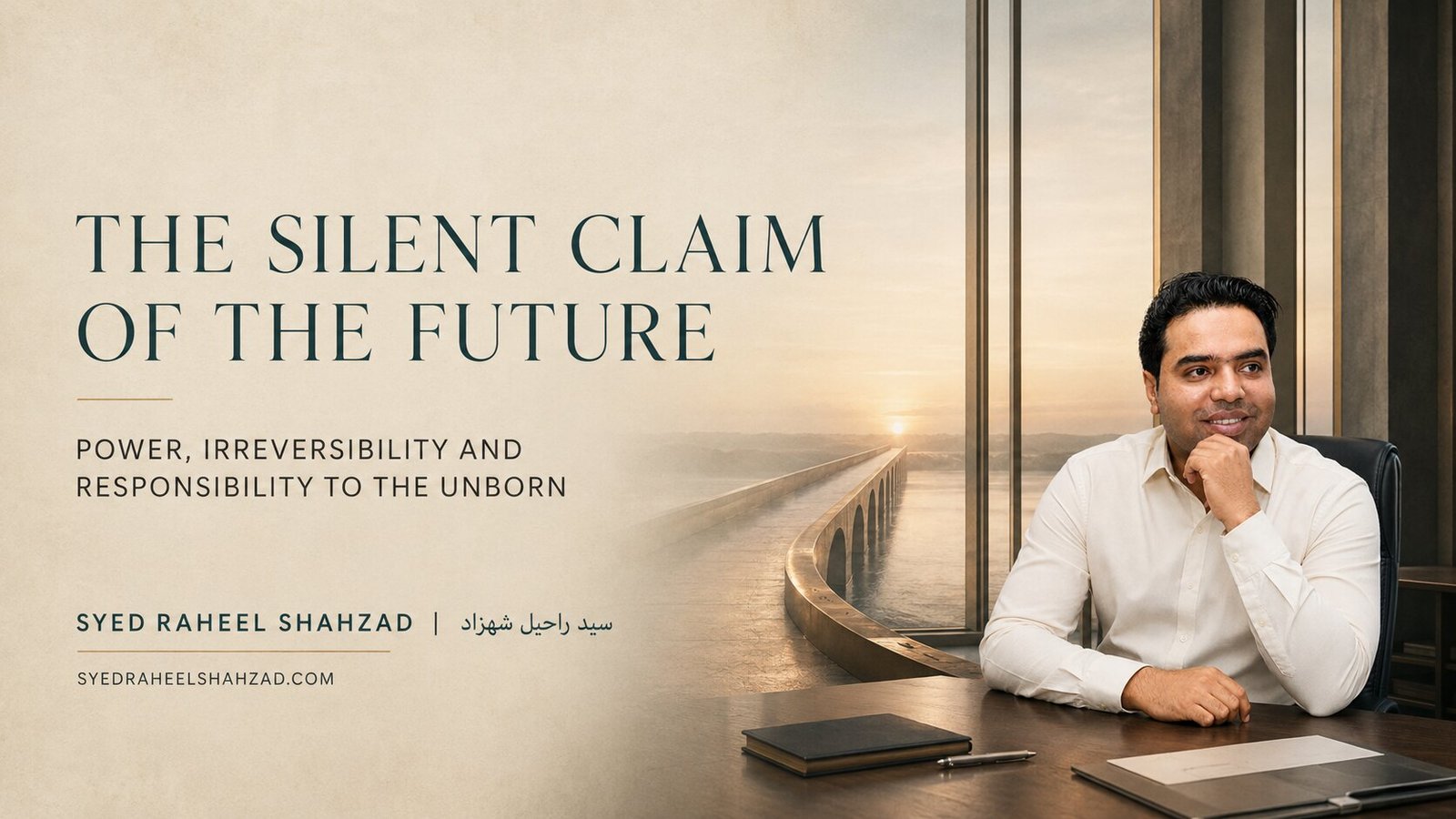
The future enters every serious decision without being present at the table. It does not speak, vote, negotiate, threaten, reward or withdraw consent. Yet it will live inside the conditions we produce. Roads will already have been placed. Institutions will already have acquired habits. Technologies will already have altered what can be known, controlled or reversed. Debts will already have claims. Damage will already have a geography.
This is the silent claim of the future: those who cannot participate in our choices may nevertheless become their most permanent subjects.
The absence of a voice does not prove the absence of a claim. It may reveal only that power arrived earlier than the person who must answer to it.
The present possesses power, not ownership
Every generation receives a world it did not design. Language, law, infrastructure, borders, institutions and moral vocabulary arrive before individual consent. This inheritance is unavoidable. Human beings begin within conditions because no life begins from a neutral platform.
But the inevitability of inheritance does not justify carelessness in what is handed forward. The present generation has custody over conditions it can alter; it does not own the entire meaning of those conditions. Possession of decision-making power is a fact. A right to use that power without regard to successors does not follow from the fact.
The distinction is foundational. Power tells us who can cause an outcome. Responsibility asks who must be considered before causing it.
Why the unborn can matter before they exist
A common objection is that people who do not yet exist cannot hold claims. They have no present preferences, identities or voices. Moreover, some decisions change not only the quality of future lives but which people will exist. How, then, can a specific future person say that a different policy would have been better for them if that policy might have resulted in someone else being born?
This problem is intellectually serious, but it does not erase responsibility. Moral concern need not depend upon identifying a future claimant by name. We already recognize duties not to create foreseeably degrading conditions for whoever occupies a role: the next patient, the next tenant, the next employee, the next citizen. The identity may be unknown while the structure of exposure is clear.
We do not need to know who will cross a bridge in order to be responsible for whether it is safe.
The asymmetry of irreversible decisions
Not all decisions deserve the same moral weight. Some can be corrected cheaply. Others close possibilities. Extinction, permanent contamination, unpayable public debt, the destruction of archives, constitutional corrosion, irreversible surveillance systems and technologies that remove meaningful human control alter the range of futures available to people who did not authorize the narrowing.
Irreversibility creates an asymmetry. The present can impose; the future cannot return to the moment of choice. Later people may adapt, but adaptation is not retroactive consent. They may become skilled at surviving a damaged arrangement while still having been wronged by its avoidable creation.
The more irreversible an intervention, the stronger the burden of justification should become. Capability alone is weakest precisely where its consequences are longest.
Moral distance is not moral disappearance
Human attention is naturally drawn toward visible suffering. A person in front of us can describe pain and activate sympathy. Future harm is statistical, delayed and politically quiet. This makes it easy to discount.
Economic discounting may sometimes express reasonable uncertainty or changing resource values. Moral discounting is different. A person does not become less human because their life occurs later. Time can affect what we know and what we can feasibly do; it cannot by itself reduce the basic significance of avoidable suffering.
If the same preventable harm would be wrong when imposed tomorrow, delay alone cannot transform it into moral permission.
Representation without presence
Political systems are built around existing constituencies. Leaders answer to current voters, consumers, investors, donors and media cycles. Future people supply none of these pressures. Their silence is therefore converted into an institutional disadvantage.
Representation of the future cannot mean inventing precise preferences for people whose cultures and circumstances are unknown. It means protecting the preconditions of meaningful choice: a livable environment, functioning institutions, reliable knowledge, public solvency, human agency, peace, and a range of options not needlessly destroyed in advance.
We should not dictate the future’s conclusions. We should resist making its conclusions impossible.
The danger of speaking for the future
Concern for future generations can itself become a language of domination. Present authorities may claim to know what history requires and use imagined descendants to silence living people, especially those already vulnerable. A distant benefit can become an excuse for immediate injustice.
Ethical futurity therefore needs two constraints. First, future protection must not erase the dignity and rights of people alive now. Second, claims made on behalf of the future must remain evidence-based, reviewable and open to contest. No leader should acquire unlimited present authority merely by declaring a long horizon.
The future needs representation, not ventriloquism.
Responsibility under uncertainty
We cannot predict complex systems perfectly. But uncertainty cuts in two directions. It may weaken confidence in a forecast; it can also strengthen caution where losses would be catastrophic or irreversible. “We do not know exactly” is not equivalent to “nothing is owed.”
A responsible decision distinguishes uncertainty about whether harm will occur, uncertainty about its scale, and uncertainty about whether it can be repaired. Where probability is contested but exposure is immense and repair impossible, humility supports restraint rather than indifference.
Seven tests for decisions that outlive their makers
1. Duration: How long will the material consequences remain after the decision-makers leave?
2. Reversibility: Can later people change course without bearing intolerable cost?
3. Distribution: Who receives the benefit now, and who inherits the risk later?
4. Option value: Does the decision preserve or unnecessarily close future choices?
5. Knowledge: What is known, what is uncertain, and who benefits from treating uncertainty as permission?
6. Representation: Has anyone been formally tasked with arguing from the standpoint of long-term public consequence?
7. Repair: Are resources, records and legal mechanisms reserved for correction if assumptions fail?
Stewardship is not nostalgia
Responsibility to the future does not require freezing the present. Innovation, construction and institutional reform necessarily change inherited conditions. The moral demand is not preservation of everything. It is discrimination between transformation that enlarges human possibility and transformation that consumes possibilities for narrow immediate gain.
Stewardship asks us to pass forward systems capable of learning. A resilient inheritance contains not only assets but correction mechanisms: transparent records, independent institutions, distributed knowledge, recoverable infrastructure and a culture that permits error to be named before it becomes destiny.
The author and the heir
We often imagine ourselves as owners of the present. A more accurate image is that we are temporary authors of conditions whose final readers we will never meet. The text will continue after the hand has left the page.
This does not make us guilty for every future hardship. Responsibility has limits of knowledge, capacity and causal connection. But where we possess unusual power, credible foresight and alternatives, the excuse of temporal distance becomes thin.
The unborn cannot thank us for restraint. They cannot punish us for neglect. Their claim is therefore a test of moral seriousness precisely because it offers no immediate reward.
The silent claim
Justice is easiest when the claimant is visible, organized and capable of retaliation. Its deeper form appears when power recognizes a boundary before resistance can enforce one.
The future has no vote in today’s room. It has no representative unless we create one, no evidence unless we preserve it, and no freedom from our decisions unless we leave room for correction. Yet it will inherit the architecture of what we normalize.
We do not owe future people a perfect world. We owe them something more disciplined: a world not knowingly stripped of the conditions through which they might repair, choose, understand and become.
Their silence is not consent. It is the distance across which responsibility must learn to hear.