Philosophical Essay · Moral Remainder, Residual Obligation, Regret, Justice and Non-Ideal Choice
The Ethics of Moral Remainder: Why the Right Choice Can Still Leave Something Owed
A philosophical inquiry into the residue of value that can survive a justified decision: the loss that remains real, the claim that remains morally visible, and the responsibility that does not disappear merely because the best available choice was made.
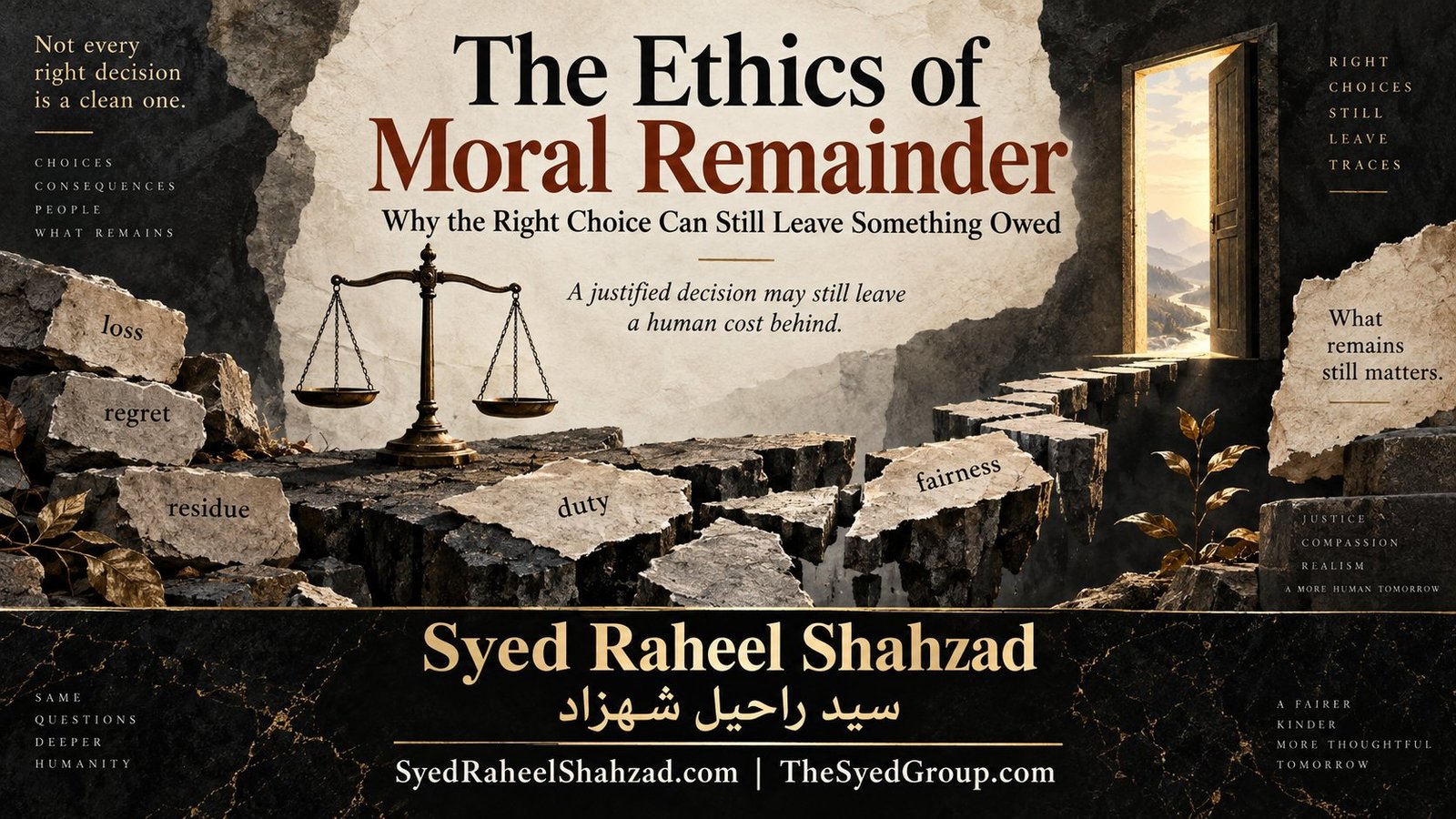
Some decisions are difficult because we do not know what is right. Others are difficult for a more disturbing reason: we know what must be done, yet doing it still injures something we have reason to value.
Modern moral language often treats right action as though it should produce moral cleanliness. If the decision was justified, the story appears finished. If the rule was followed, the conscience should be quiet. If the greater good was served, whatever was lost is expected to disappear into the arithmetic.
Human experience is rarely so tidy.
A right choice can settle what we should do without settling everything we should still care about.
The fantasy of the clean decision
We are attracted to moral theories that promise a clean ending. They allow us to imagine that once a choice has been correctly classified, all remaining discomfort is irrational. But many serious choices involve plural values: duties, relationships, promises, safety, loyalty, fairness, mercy, truth, and future consequences that cannot all be preserved at once.
When two genuine values collide, choosing one does not prove that the other was unreal. The rejected value can continue to make a claim on our moral attention even after the choice is justified.
This surviving claim is what I call the moral remainder.
Moral remainder is not proof of wrongdoing
The first distinction is essential. Moral remainder is not the same as moral error.
A surgeon may choose the treatment most likely to save a patient and still grieve the injury that treatment necessarily causes. A parent may enforce a boundary that is genuinely needed and still mourn the closeness temporarily lost. A leader may close a failing program to protect an institution and still recognize the real people whose work, identity, or access was attached to it.
Regret in such cases does not automatically mean the decision was wrong. It may mean the decision-maker has remained morally awake to what the decision cost.
What survives the decision
A difficult choice can leave several kinds of remainder.
- Loss: something valuable no longer exists because the decision could not preserve it.
- Residual obligation: a person whose claim could not be fully honored may still deserve explanation, compensation, protection, apology, or future priority.
- Regret: not regret that one chose wrongly, but regret that reality required this choice at all.
- Memory: the decision should continue to teach us about the structure that made the conflict unavoidable.
- Humility: even justified power should remember the people who paid for its exercise.
Why regret can be morally intelligent
We often treat regret as a symptom to eliminate. Yet there is a form of regret that is morally perceptive. It says: I still see what was lost.
A person who feels nothing after imposing unavoidable harm may be emotionally efficient, but efficiency is not the same as ethical maturity. The capacity to proceed with a necessary decision while retaining sensitivity to the defeated value is part of what keeps strength from becoming cruelty.
Moral maturity is not the ability to make hard choices without feeling. It is the ability to choose without allowing necessity to erase the value of what could not be chosen.
The danger of retrospective purification
After difficult decisions, people often rewrite the past to make the choice feel cleaner. The person we could not help becomes less deserving. The relationship we ended becomes entirely bad. The employee we dismissed becomes useless. The policy we abandoned becomes foolish. We reduce the value of what was lost so that the surviving path feels unquestionably right.
This psychological maneuver protects the chooser, but it distorts reality.
Sometimes the road not taken was genuinely good. It was simply incompatible with another obligation that carried greater weight under the circumstances.
Right action does not cancel residual duty
Suppose an institution has resources for only ten people although twenty have legitimate claims. A fair procedure may determine who receives help. The decision can be justified. Yet the ten people left without support do not become morally irrelevant merely because the process was fair.
Their unmet claims can generate further duties: transparency about the decision, assistance finding alternatives, priority when resources expand, redesign of the system, or political pressure to reduce the scarcity itself.
Justice is therefore not exhausted by choosing correctly inside a bad situation. Justice also asks what we owe because the bad situation existed.
Tragic choice and the structure of reality
Some moral conflicts are tragic not because every option is equally wrong, but because every option destroys something worth protecting. The tragedy lies in the structure of the situation.
This matters because human beings sometimes convert structural tragedy into personal self-condemnation. We assume that if pain remains, someone must have made the wrong choice. That inference is false.
A finite human life cannot preserve every good simultaneously. Time is limited. Attention is limited. Institutions have capacity limits. Duties collide. Historical conditions constrain us. A morally serious life therefore requires not only principles for choosing, but a philosophy for living with what right choice cannot save.
When remainder becomes responsibility
Not every remainder generates the same obligation. Some losses cannot be repaired. Some can be compensated. Some deserve acknowledgment. Some demand institutional change. The important question is not whether something remains, but what kind of response the remainder morally requires.
- What legitimate value was sacrificed by the decision?
- Who carries the cost of that sacrifice?
- Was the loss truly necessary, or merely convenient?
- What explanation is owed to those affected?
- Can any part of the loss be repaired, compensated, or reduced?
- Should the affected person receive future priority?
- What structural change could prevent the same conflict from recurring?
- What should remain in institutional or personal memory after the decision is complete?
Leadership after the decision
Leadership is often judged by decisiveness. But the deeper moral test begins after the decision. Can the leader remain in relationship with those who lost? Can the institution acknowledge legitimate disappointment without treating dissent as disloyalty? Can power explain itself without pretending that necessity made everyone whole?
A mature leader does not say, “The decision was right, therefore nothing is owed.” A mature leader can say, “The decision was necessary, and because it cost you something real, we still have responsibilities.”
Compassion without paralysis
Recognition of moral remainder should not make action impossible. If every cost became a reason never to decide, responsibility would collapse into avoidance.
The purpose of moral remainder is not to weaken action. It is to prevent justified action from becoming morally self-congratulatory. We can decide firmly and still remain compassionate. We can accept necessity without worshiping it. We can refuse self-punishment while still honoring the people and values that could not be preserved.
A life without moral erasure
There is wisdom in allowing some decisions to remain complicated. We do not need to convert every painful choice into a victory narrative. We do not need to declare the lost path worthless. We do not need to punish ourselves forever either.
We can instead develop a more truthful moral vocabulary: I chose as responsibly as I could. Something valuable was still lost. I remain answerable to what can still be repaired, and I refuse to deny the reality of what could not be saved.
The deepest form of responsibility may be the willingness to let a justified choice remain morally unfinished.
Conclusion
The ethics of moral remainder begins where simple moral accounting ends. It recognizes that right action can coexist with grief, justified decisions can leave residual claims, and moral clarity does not require emotional numbness.
A more humane philosophy of responsibility must therefore ask two questions rather than one. First: What should I choose? Then, after choosing: What remains?
The second question is not evidence that the first answer failed. Sometimes it is evidence that we have finally understood the full moral weight of choosing at all.

Syed Raheel Shahzad — سيد راحيل شهزاد
Philosopher · Author · Founder & Group CEO · Business Strategist · Systems Thinker & Architect
This essay forms part of the continuing philosophical and systems-writing program of Syed Raheel Shahzad, author of The Source of Truth System™, The Architect’s Protocol, the Qur’anic Coherence System, Adam and the Answerable Being, and Tomorrow Became a Country.
ISNI 0000 0005 3022 8433 · ORCID 0009-0001-7323-1577 · Google Scholar nRC4eGEAAAAJ
Publisher / Imprint: The Syed Group · ISNI 0000 0005 3027 5408 · Ringgold 850493