The Moral Life of Repetition: How Small Patterns Become the World We Live In
Philosophical Essay · Repetition, Habit, Norms and Character
The Moral Life of Repetition: How Small Patterns Become the World We Live In
A philosophical inquiry into habit, expectation, normalization, character, and the moral environments built by what happens again and again.
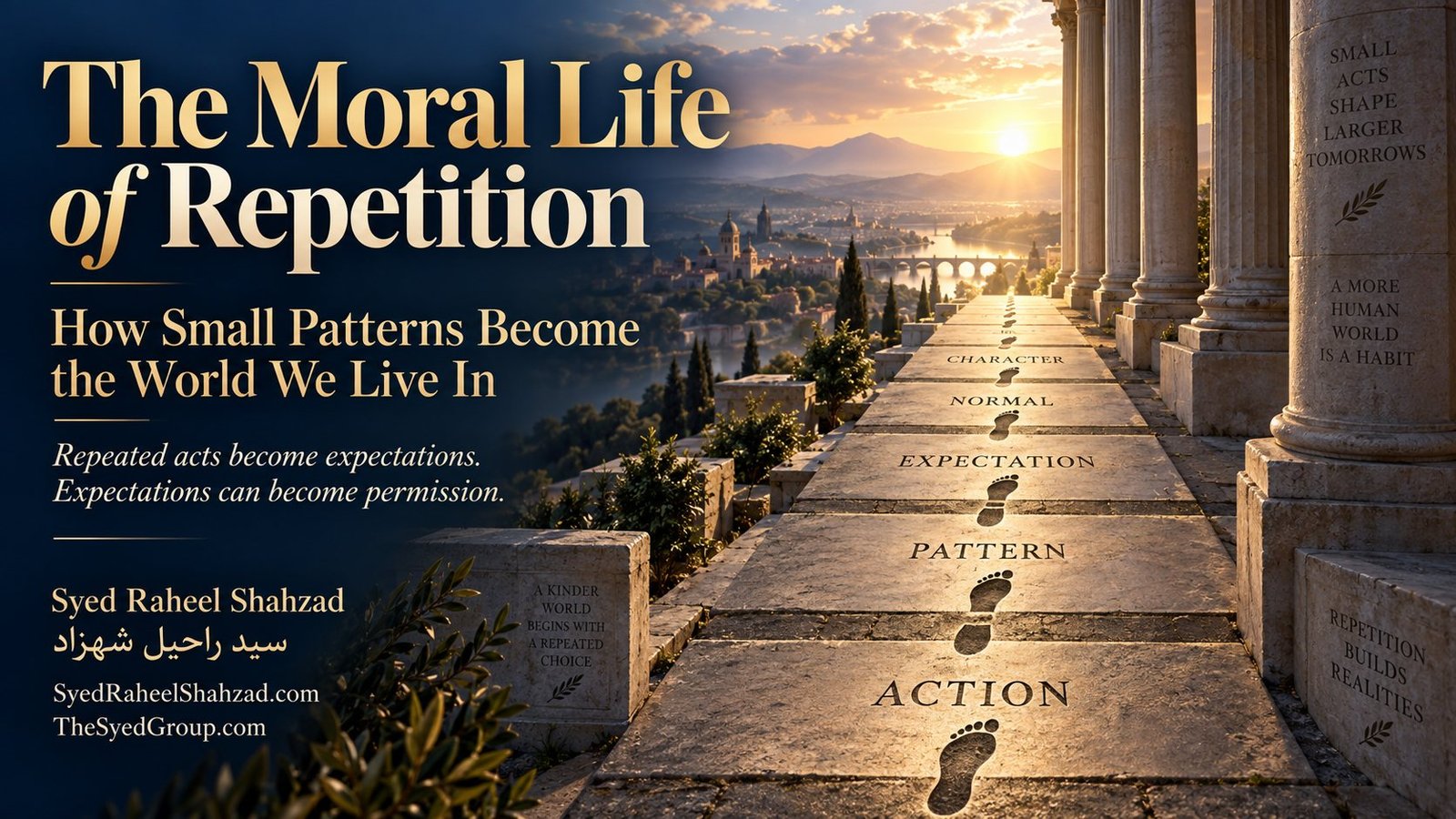
Most moral decisions do not arrive with a trumpet. They arrive as ordinary acts: a tone of voice repeated at dinner, a promise delayed again, a rule quietly ignored, a kindness offered without being asked, a small dishonesty nobody challenges, a habit of listening, a habit of interrupting, a habit of explaining away what should have been corrected.
Because each act is small, we are tempted to judge it in isolation. We ask whether this one moment is serious enough to matter. But human life is rarely formed by isolated moments alone. It is formed by patterns. What happens once may be an exception. What happens repeatedly begins to create an expectation. And expectation can slowly become permission.
A repeated act does more than happen again. It teaches the people around it what to expect, what to tolerate, and eventually what to call normal.
The difference between an event and an environment
An event is something that happens. An environment is something within which other things happen. Repetition is one of the mechanisms by which the first becomes the second.
One insult can wound. Repeated insult can reorganize a relationship. One unexplained exception can confuse a workplace. Repeated exceptions can teach everyone that the written rule is not the real rule. One thoughtful conversation can help. Repeated thoughtful conversations can make honesty safer.
This is why the moral weight of repetition is greater than the sum of identical acts. Repetition changes context. The fifth occurrence takes place in a world partly created by the previous four.
When a behavior repeats, people begin adjusting themselves around it. They anticipate it. They prepare for it. They stop being surprised. Some resist; some withdraw; some imitate; some reinterpret their own standards in order to survive the pattern. The behavior is no longer merely something a person does. It has become part of the architecture everyone else must inhabit.
Familiarity can quiet alarm without correcting wrong
Human beings adapt. Adaptation is one of our great strengths. Without it, every recurring difficulty would exhaust us as though it were new. But moral life has a danger hidden inside this strength: we can become accustomed to what should still concern us.
The first time a boundary is crossed, the mind notices. The tenth time, it may merely register. The fiftieth time, people may start describing the pattern as personality, culture, tradition, pressure, reality, or simply “how things are.”
Nothing in that sequence proves that the behavior became better. Only our reaction became quieter.
There is an important distinction between normal as “frequently occurring” and normal as “morally acceptable.” Human communities often collapse the two. Once something becomes common enough, familiarity lends it an appearance of legitimacy it never earned.
Repetition creates expectation
Expectations are not passive predictions. They shape conduct.
If a child repeatedly learns that questions are punished, the child does not simply predict punishment; the child may stop asking. If an employee repeatedly sees that bad news is punished while optimism is rewarded, the employee may learn to hide risk. If a family repeatedly experiences apology as weakness, members may learn to defend themselves even when they know they were wrong.
The expectation created by repetition therefore changes future behavior. A pattern produces responses that help preserve the pattern.
This is one reason unhealthy systems can look strangely stable. Their stability may not be evidence that everyone agrees. It may be evidence that everyone has learned what the environment permits.
Expectation can become permission
Permission does not always take the form of explicit approval. Often it appears as the absence of meaningful consequence.
What a family repeatedly ignores, a child can learn is tolerable. What leadership repeatedly excuses, an organization can learn is permitted. What friends repeatedly laugh away, a group can learn is safe to repeat. What a society repeatedly rewards, people learn to pursue even when its stated values say otherwise.
Silence can therefore participate in norm formation. Not every silence is consent; people may be afraid, tired, dependent, uncertain or strategically patient. But from the perspective of the repeating behavior, the practical effect can still be reinforcement when nothing in the environment signals a limit.
This does not mean every minor wrong demands confrontation. Moral maturity includes proportion. But it does mean we should notice when our desire to avoid discomfort is helping a pattern acquire permanence.
Character is partly a history of repetition
We often speak of character as though it were a possession hidden inside a person: someone “has integrity” or “lacks discipline.” Yet character is also enacted. It is built through recurring choices until certain responses become more available, more automatic and more believable to oneself.
A person does not become reliable by making one promise. Reliability is the accumulated evidence of promises kept when keeping them became inconvenient. Courage is not one dramatic display; it is often a repeated willingness to face smaller truths before a crisis arrives. Cruelty, too, can be rehearsed. So can indifference.
Repetition matters because the act is not only changing the world outside us. It is training the person who performs it.
Every repeated choice is practice for the kind of person who will make the next choice.
The moral danger of “only this once”
Most destructive patterns do not begin with a declaration that they will become permanent. They begin with exceptions.
Only this once I will hide the problem. Only this once we will excuse the behavior. Only this once I will speak to them that way. Only this once the deadline will not matter. Only this once we will choose convenience over principle.
Sometimes an exception is genuinely justified. Rules are not sacred merely because they are rules. But the phrase “only this once” should make us curious about what the act teaches if repeated. A pattern is often an exception that survived long enough to lose its name.
Institutions have habits too
Organizations often describe culture through values statements. People usually learn culture through recurrence.
They watch who gets heard. They notice which problems are investigated and which are buried. They observe whether leaders apologize, whether performance excuses misconduct, whether difficult truth is welcomed or punished, whether ordinary people can challenge a decision, and whether rules apply upward as well as downward.
Policy matters. But policy is interpretation until repetition gives it credibility.
If an institution says “people first” while repeatedly rewarding behavior that exhausts people, the repeated pattern teaches more effectively than the slogan. If it says “speak up” but those who raise concerns repeatedly suffer, the actual lesson is silence.
The positive power of normalization
Normalization is not only a story about harm. The same mechanism can build good worlds.
A home can normalize apology. A team can normalize asking for evidence. A school can normalize curiosity. A leader can normalize saying, “I was wrong.” A friendship can normalize honest disagreement without humiliation. An institution can normalize fair review so thoroughly that favoritism begins to feel abnormal.
This is one of the hopeful facts about repetition: culture is not fixed merely because it has been repeated for a long time. It was built by patterns, and patterns can be replaced by other patterns.
But replacement requires patience. One good act does not instantly dissolve a culture formed by hundreds of contrary acts. Trust often needs repeated contrary evidence before expectation changes.
Changing a pattern requires more than declaring a value
When people recognize a harmful pattern, they often announce a new intention. That matters, but intention is only the beginning. Repetition created the old expectation; repeated evidence is usually required to create the new one.
A person who has been unreliable cannot demand trust because they have now decided to be reliable. They can begin earning trust through consistency. A workplace that discouraged dissent cannot repair the problem with one invitation to “speak freely.” It must repeatedly show that honest disagreement is safe.
The moral task is therefore not merely to stop a bad act. It is to create a new pattern strong enough to alter expectation.
Notice what no longer surprises you
One of the most revealing moral exercises is to examine the things that have stopped surprising us.
What used to bother you but now feels ordinary? What do people in your environment apologize for no longer? Which shortcuts are so common they no longer feel like shortcuts? Which forms of kindness have become so dependable that people quietly build their lives around them?
Loss of surprise can indicate maturity: we should not remain shocked by ordinary human imperfection. But it can also indicate moral anesthesia. The difference is whether deeper understanding has improved our judgment or repeated exposure has merely lowered our alarm.
The world is built at the scale of recurrence
We imagine that the future is made mainly by major decisions. Some of it is. But much of the world we eventually inhabit is constructed through things too small to appear historic while they are happening.
The greeting repeated every morning. The rule repeatedly enforced fairly. The sarcasm repeatedly tolerated. The child repeatedly listened to. The risk repeatedly hidden. The truth repeatedly spoken. The vulnerable person repeatedly included. The promise repeatedly kept.
These acts accumulate into expectations; expectations become norms; norms shape character; character shapes systems; systems shape the possibilities available to the people who enter them next.
That is the moral life of repetition.
Our smallest recurring choices are not small because they happen quietly. They are often the place where tomorrow is being rehearsed.